The Peter Pan statue in Kensington Gardens: the story and how to find it
J. M. Barrie had the Peter Pan statue put up overnight in 1912 so children would think fairies had brought it. Its story, what to look for and how to find it.
Exploring Kensington? This guide is part of our guide to things to do in Kensington. See also: Kensington Gardens · the Peter Pan statue · the Diana Memorial Fountain · afternoon tea at the Orangery · palace tickets.
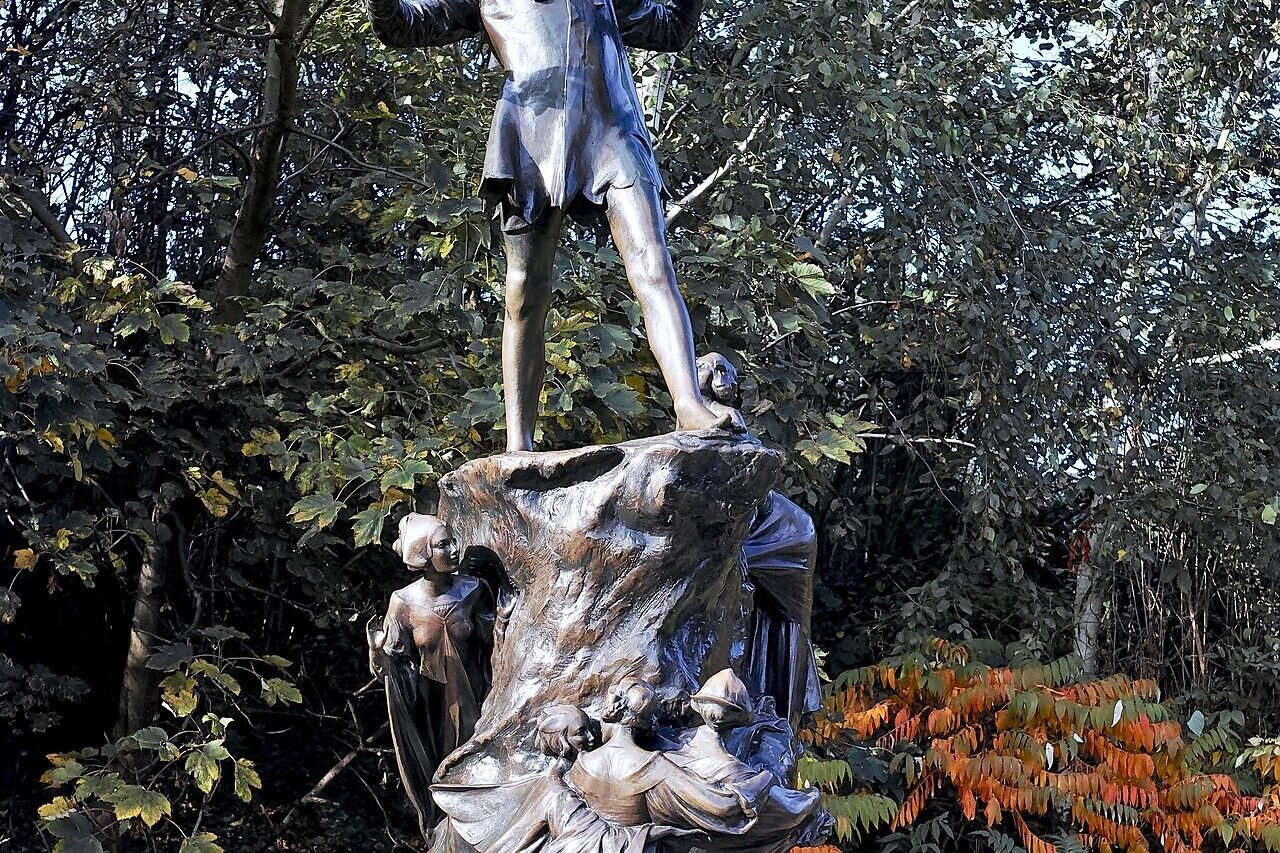
On the morning of 1 May 1912, children walking in Kensington Gardens found something new beside the Long Water: a bronze statue of a boy blowing a pipe, standing on a tree stump alive with fairies, rabbits and mice. There had been no ceremony and no announcement. That was the point. J. M. Barrie, the creator of Peter Pan, had had it put up secretly overnight so it would seem that the fairies had brought it. Over a century later it’s one of the most loved statues in London.
The story of the statue
Barrie commissioned the statue from the sculptor Sir George Frampton and paid for it himself. He had it erected during the night of 30 April 1912, without asking permission, and announced it in The Times the next day as a May Day gift to the children of London. Some critics grumbled that an author had been allowed to advertise his work in a royal park, but the statue stayed.
Barrie wasn’t entirely happy with it. He had wanted Peter to be modelled on a photograph of Michael Llewelyn Davies, one of the boys who inspired the stories, dressed as Peter Pan. Frampton used a different model, and Barrie later complained that the statue “didn’t show the Devil in Peter”. Visitors have never minded.
The statue has had its troubles: in 1928 vandals tarred and feathered it. In 2019 the Royal Parks replaced its plinth. It is listed at Grade II*, recognising it as a particularly important piece of public sculpture.
Why Kensington Gardens?
Peter Pan was born in Kensington Gardens. Barrie lived just across the road, on Bayswater Road, and walked his dog in the gardens every day. There he met the Llewelyn Davies boys and their nanny, and made up stories for them about a baby who could fly.
Peter first appeared in Barrie’s 1902 novel The Little White Bird, in which he flies out of his nursery window and lands in Kensington Gardens, where he lives with the fairies and the birds on an island in the Serpentine. The statue stands on the spot where he lands. The chapters were later published on their own as Peter Pan in Kensington Gardens (1906), with illustrations by Arthur Rackham. The play Peter Pan, or the Boy Who Wouldn’t Grow Up opened in 1904. In 1929 Barrie gave the rights to Peter Pan to Great Ormond Street Hospital for Children, which still benefits from them.
What to look for
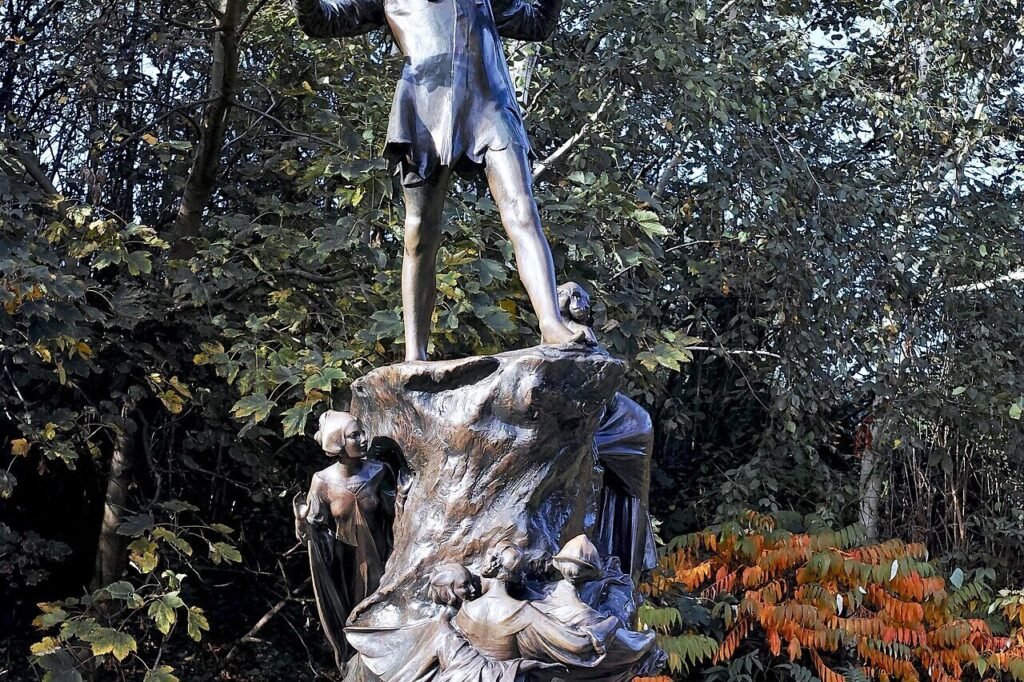
- Peter himself, on top, playing his pipes.
- The fairies climbing up the stump to listen to him. Some have been rubbed shiny by generations of small hands.
- The animals: squirrels, rabbits and mice hidden among the roots and branches. See how many children can spot.
- The setting: look out over the Long Water. Peter’s island in the story was in this lake.
Peter Pan around the world
Frampton made other casts of the statue, and six of them stand in parks around the world:
- Brussels, Belgium (Egmont Park)
- Liverpool, England (Sefton Park)
- St John’s, Newfoundland, Canada
- Toronto, Canada
- Camden, New Jersey, USA
- Perth, Western Australia
How to find it
The statue is on the west bank of the Long Water, the northern part of the Serpentine lake, in Kensington Gardens. The easiest way is from Lancaster Gate station (Central line): enter the gardens opposite the station and walk south to the water, about five minutes. From Kensington Palace it’s about 15 minutes’ walk east past the Round Pond. Kensington Gardens opens at 6am and closes at dusk; the statue is free to visit. See our guide to Kensington Gardens for opening times and the rest of the park.
A Peter Pan walk
Fans of the story can make a short walk of it, about an hour:
- Start at Leinster Corner, 100 Bayswater Road, opposite the gardens near Lancaster Gate, where Barrie lived when he wrote Peter Pan. Look for the blue plaque.
- Cross into the gardens and walk down to the Peter Pan statue on the Long Water.
- Head west past the Round Pond, where Barrie used to walk his dog and meet the Llewelyn Davies boys.
- Finish at the Diana Memorial Playground and its pirate ship, inspired by Peter Pan, and the Elfin Oak beside it.
Nearby
- The Italian Gardens, five minutes north, at the head of the Long Water.
- The Diana Memorial Playground, with its Peter Pan pirate ship, near the palace, and the Elfin Oak beside it.
- The Diana Memorial Fountain, across the Serpentine bridge in Hyde Park.
- Kensington Palace: see our ticket guide.
Questions people ask
Where is the Peter Pan statue in London?
In Kensington Gardens, on the west bank of the Long Water, a few minutes’ walk south of Lancaster Gate station.
Who made the Peter Pan statue?
Sir George Frampton, commissioned and paid for by J. M. Barrie in 1912.
Why was the Peter Pan statue put up at night?
Barrie wanted it to appear overnight as if by magic, so children would think the fairies had put it there.
Is the Peter Pan statue free to visit?
Yes. It’s in a public park and free to see whenever Kensington Gardens is open.
Some links on this page earn us a commission at no extra cost to you. How this site makes money