Diana at Kensington Palace: her home, her statue and the Sunken Garden
Diana lived at Kensington Palace for sixteen years. Her life there, her statue in the Sunken Garden, and the memorials you can visit nearby.
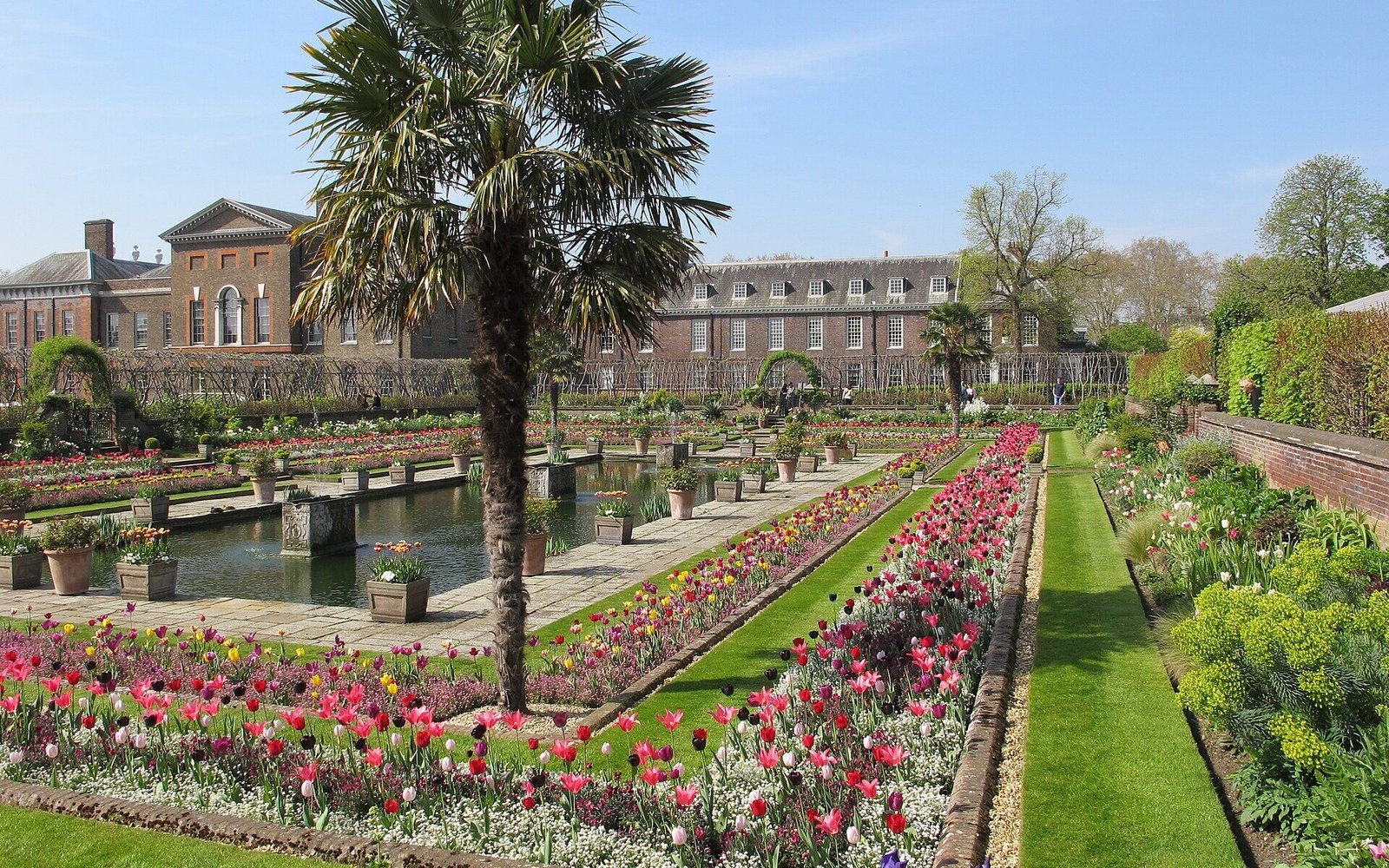
For many visitors, Kensington Palace means one person: Diana, Princess of Wales. She lived here for sixteen years, from her wedding in 1981 until her death in 1997. She raised Prince William and Prince Harry here, and in the days after her death the palace gates disappeared under a sea of flowers. Today her statue stands in the palace’s Sunken Garden, the garden she loved to walk past, and the parks around the palace hold three more memorials to her. This is the story of Diana at Kensington, and where to find her today.
Diana’s home at Kensington
After their wedding at St Paul’s Cathedral on 29 July 1981, the Prince and Princess of Wales were given Apartments 8 and 9, on the north side of the palace, as their London home. They split their time between Kensington and Highgrove, their house in Gloucestershire. Kensington was where the boys grew up: William was born in June 1982 and Harry in September 1984, and both spent their childhood here.
When the marriage broke down, Charles moved out and Diana stayed. After the couple separated in 1992, and after their divorce in 1996, Kensington Palace remained her home and her office. It was here that she received friends and planned the charity work on landmines, HIV and homelessness for which she became famous, and from here that she took the boys out into Kensington Gardens.
August 1997: the sea of flowers
Diana died in a car crash in Paris in the early hours of 31 August 1997. Within hours, people began to leave flowers at the gates of Kensington Palace. Within days the bouquets stretched far out into Kensington Gardens, several feet deep in places, with candles, cards, photographs and teddy bears among them. Hundreds of thousands of people came to add their own. On the morning of her funeral, 6 September, her coffin left Kensington Palace for Westminster Abbey, followed for the last part of the way by her sons, her brother, Prince Charles and Prince Philip.
Every year since, a few people leave flowers at the gates on the anniversary of her death, and on 1 July, her birthday.
The statue of Diana
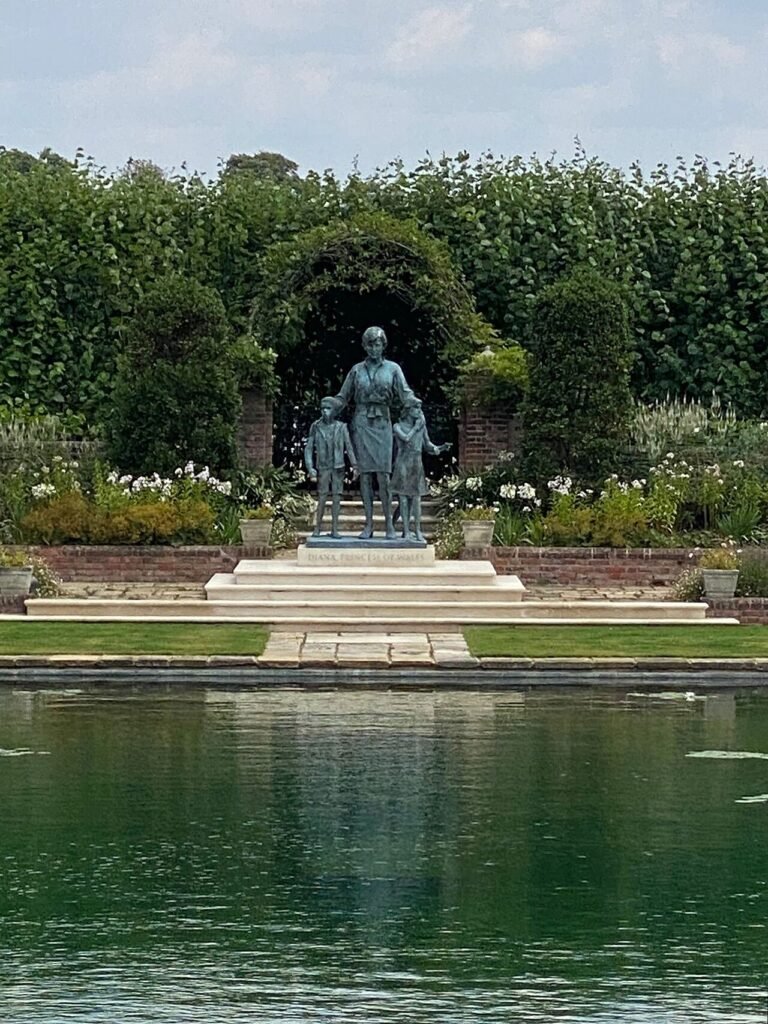
On 1 July 2021, what would have been Diana’s 60th birthday, Prince William and Prince Harry unveiled a bronze statue of their mother in the Sunken Garden. It was a rare joint appearance at a time when the brothers were known to be estranged, and the unveiling was kept small because of Covid restrictions.
The sculptor, Ian Rank-Broadley, is best known for the portrait of Queen Elizabeth II used on British coins from 1998. He shows Diana in her later years, in a simple, belted dress, surrounded by three children. According to the palace, the children represent the universality and generational impact of her work. In the paving in front of the statue is an engraved stone with lines from the poem “The Measure of a Man”.
The statue has since become one of the most photographed spots in Kensington, and the queue to see it can be long on summer weekends.
The Sunken Garden
The Sunken Garden, just south-east of the palace, was laid out in 1908 in the style of an old English garden. Its terraces step down to a long, rectangular pond, and it’s surrounded by an arbour of pleached limes, a tunnel of trained trees with gaps cut into it so you can look in. Its design is said to have been inspired by the old pond gardens at Hampton Court, our sister site.
Diana is said to have loved this garden, and the gardeners often talked with her as she passed. In 2017, for the twentieth anniversary of her death, it was replanted as a White Garden, full of white flowers inspired by her life, image and style. For the statue in 2021 it was redesigned again by the landscape designer Pip Morrison, with thousands of flowers, forget-me-nots among them. The borders change through the seasons, so the garden looks different every time you visit.
Diana memorials near the palace
- The Diana Memorial Playground, beside the palace in Kensington Gardens. It opened in 2000 and is inspired by Peter Pan, with a wooden pirate ship. Diana’s love of children and her own sons’ childhood here made it a fitting tribute.
- The Diana Memorial Fountain, in Hyde Park, on the south side of the Serpentine. It was opened by Queen Elizabeth II in 2004: a ring of Cornish granite where water flows in two directions and meets in a calm pool. You can sit on the edge and dip your feet in.
- The Diana Memorial Walk, a seven-mile route through four royal parks, marked by plaques set into the ground. It passes the palace, the playground and the fountain.
For more on the park around the palace, see our guide to Kensington Gardens.
A Diana walk around Kensington
You can see everything connected with Diana in Kensington in about an hour and a half on foot. Start at High Street Kensington station and walk north into the park.
- The palace gates. The gilded gates on the south side of the palace, facing Kensington Road, are where the flowers were left in 1997.
- The Sunken Garden. Follow the path round to the east side of the palace and look through the gaps in the lime arbour, then go in to see the statue.
- The Orangery. A few steps north, Queen Anne’s Orangery is the place for coffee or afternoon tea.
- The Diana Memorial Playground. Continue north along the Broad Walk to the pirate ship. Only adults with children can go in, but you can see it from the railings.
- The Round Pond and the Long Water. Cut east past the Round Pond, then follow the Long Water south past the Peter Pan statue to the Serpentine Bridge.
- The Diana Memorial Fountain. Cross the bridge into Hyde Park and the fountain is just below you, on the south bank of the Serpentine. Knightsbridge station is about 15 minutes’ walk away.
Look out for the round metal plaques of the Diana Memorial Walk set into the paths as you go. They’ll lead you on to Green Park and St James’s Park if you want to keep walking.
Diana’s dresses at the palace
Kensington Palace has held major exhibitions about Diana. Diana: Her Fashion Story (2017 to 2019) traced her style from the romantic dresses of the early 1980s to the sleek designer suits of her last years. In 2021 Royal Style in the Making put her wedding dress, by David and Elizabeth Emanuel, on display at the palace for the first time in 25 years. There is no Diana exhibition at the palace this winter, but displays change regularly. Check the official website to see what’s on when you visit.
Visiting
The Sunken Garden and the palace gardens are free. In winter they are open Wednesday to Sunday, from 10am to 4pm. You don’t need a palace ticket to see the statue. If you’d like to go inside, a ticket covers the King’s State Apartments and Victoria’s childhood rooms. See our ticket guide for this winter’s prices. Diana’s former apartments are private and not open to visitors.
The best way to understand Diana’s Kensington is with a guide. A guided walk through royal Kensington with afternoon tea passes the palace, the gardens and the places connected with her, and ends with tea. For the wider story, read who lives at Kensington Palace today.
Questions people ask
Where is the Princess Diana statue?
In the Sunken Garden at Kensington Palace, on the south-east side of the palace. It’s free to visit during the garden’s opening hours.
When was the Diana statue unveiled?
On 1 July 2021, on what would have been her 60th birthday, by Prince William and Prince Harry.
Which apartment did Diana live in at Kensington Palace?
Apartments 8 and 9, on the north side of the palace, from 1981 until her death in 1997.
Can you go inside Diana’s apartment?
No. Her former apartments are private. The state apartments and the gardens are open to visitors.
Some links on this page earn us a commission at no extra cost to you. How this site makes money